Net Deferred Tax Assets and Liabilities, a Valuation Adjustment

Deferred tax accounts arise because of differences in how firms and the government account for taxes. For example, whereas the government uses accelerated depreciation to calculate taxes owed, firms employ straight-line depreciation. The taxes the company will actually pay, its “cash taxes”, will be lower than the tax expense or provision for income taxes that it will report. 

When the business’ reported income is less than its taxable income, the firm generates deferred tax assets (DTAs), whereas when its reported income is greater than its taxable income, deferred tax liabilities (DTLs) are created. They are either reported on the face of the balance sheet, or off its face, hidden away in the notes. DTAs increase a firm’s reported assets, whereas, DTLs can be seen as a kind of interest-free debt.

“Deferred Tax Assets and Liabilities, an Invested Capital Adjustment”, Joseph Noko

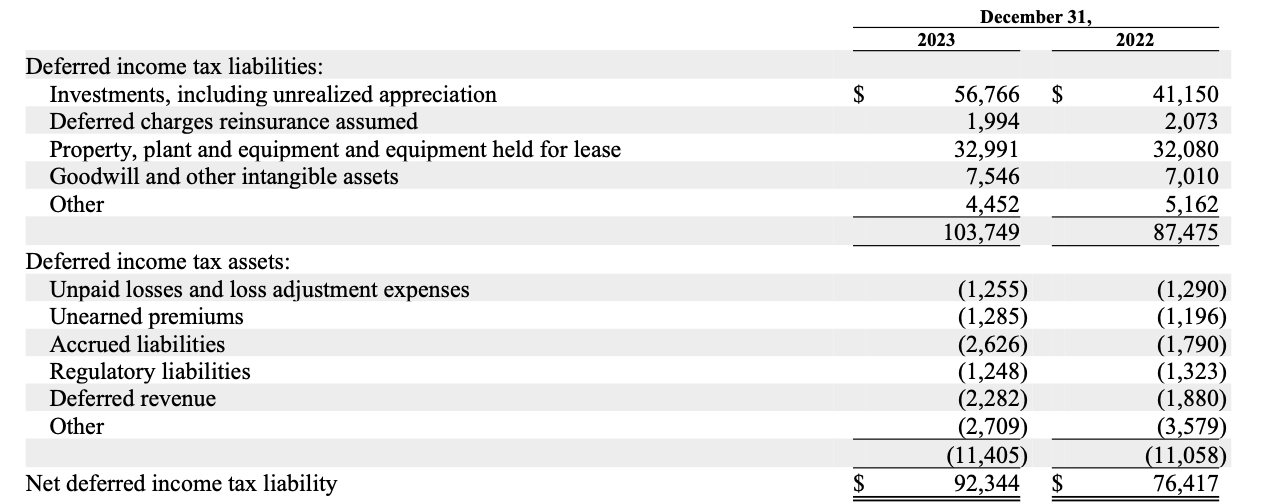
In my calculation of economic book value (EBV), I deduct DTLs, net of DTAs because they are real obligations that will have to be paid in future, reducing shareholder value. DTAs, net of DTLs, on the other hand, are not added to EBV because they cannot be converted into shareholder value, by selling them, for example, and, because they do not represent real value. The most famous example of net DTLs is Berkshire Hathaway, who, in page K-103 of their 2023 annual report, disclosed net DTLs of $92.34 billion. 
Pension Net Funded Status, a Valuation Adjustment

As I discussed in “Overfunded Pension Plan Assets, an Invested Capital Adjustment”, under SFAS 158, companies are obliged to  report the net funded status of their pensions, which is the difference between the fair value of their pension plan assets and the plans’ projected benefit obligation, i.e. the present value of their future pension obligations. Underfunded plans are, in effect, borrowings from employees and will require repayment at some point in the future and so, the degree of underfunding is deducted from my calculation of economic book value (EBV). Overfunded plans have dead capital that is not required to generate a return to meet projected benefit obligations and so, this is added to my calculation of EBV.

Adjusted Total Debt, a Valuation Adjustment

The adjusted total debt of a firm is the sum of the fair value of all its short and long-term obligations, on-balance sheet and off-balance sheet. For example, in 2023, the combination of Meta Platform’s on-balance sheet debt and its operating, variable and not-yet commenced leases, gave it an adjusted total debt of $47 billion, $10 billion greater than the operating lease liabilities, and long-term debt the company reported on its balance sheet. This was due to the impact of its variable and not-yet commenced leases. Without digging into the company’s notes, this would go undetected. I subtract this value from my calculation of economic book value (EBV) to reflect the priority debtholders have over shareholders.

Non-Controlling Interests, a Valuation Adjustment

When a company has majority control of a subsidiary but does not own 100 percent, the entire subsidiary must be consolidated on the parent company’s balance sheet. The funding other investors provide for this subsidiary is recognised on the parent company’s balance sheet as non-controlling interests (formerly called minority interest). When valuing non-controlling interests, it is important to realise that the minority interest holder does not have a claim on the company’s assets, but rather a claim on the subsidiary’s assets.

Valuation: Measuring and Managing the Value of Companies, Tim Koller, Marc Goedhart, and David Wessels

The fair value of non-controlling interest liability is subtracted from shareholder value in my reverse discounted cash flow (DCF) models to reflect the reality that non-controlling interests have claims on cash flows, reducing economic book value (EBV).

Preferred Stock, a Valuation Adjustment

Preferred stock is a form of hybrid financing that has the qualities of both equity and debt. In terms of claims on assets and cash flows, preferred stock is senior to ordinary shares, but below bonds, and may have priority over ordinary shares when dividends are paid or the business is liquidated. They may also be convertible into ordinary shares. By their nature, they divert future cash flows away from shareholders, and so they must be removed from calculations of shareholder value, reducing the firm’s economic book value (EBV).

Deferred Compensation Assets, an Invested Capital Adjustment

Deferred compensation is that portion of employee compensation that has been set aside for future payment. Firms create plans to manage the assets that will be used to settle these liabilities. Consequently, deferred compensation assets are a non-operating liability, which is to say that they are not part of the invested capital that is used to earn net operating profit after tax (NOPAT) for shareholders. 

Firms may report its deferred compensation assets on the face of the balance sheet, which makes discovery a trivial affair, or, off the face of the balance sheet, hidden in its notes. The former requires an exegesis of the nomenclature, while the latter requires a work of excavation that analysts and investors are usually not willing to do.

Scroll to Top