Outstanding Employee Stock Options, a Valuation Adjustment

Effective 2005, the IASB required employee stock options (ESO) to be expensed in the income statement, with the FASB following a year later. Until then, firms could treat ESO compensation as if it was not a cost, inflating their reported earnings. Consequently, for the era before this accounting change, one must dig up data from the footnotes in order to calculate the cost of ESO issuances and ensure that results are comparable across periods and add the charge to net income so as to arrive at a better measure of NOPAT.

“Employee Stock Option Costs and Goodwill Amortisation, a NOPAT Adjustment”, Joseph Noko

Not only are ESOs a compensation effect that impacts profitability, they are also an obligation to pay employees in shares, in a process of share dilution. There are three ways to value a firm’s ESOs: using company-disclosed fair value, which may be taken at face value if one’s estimate of share price is near that underpinning the option values in the notes to the annual report; option pricing models such as Black-Scholes or more advanced binomial (lattice) models, which, under U.S. GAAP and IFRS, firms use to estimate the total value of all ESOs outstanding; and the exercise value approach, which gives a lower bound for the value of ESOs. In practice, the reported aggregate intrinsic value and the result obtained using Black-Scholes, should be within a narrow range of each other, so I usually elect to use the reported values, unless I see fit to do otherwise. I then subtract this value from my economic book value (EBV) calculation and from the present value of future cash flows in my reverse discounted cash flow (DCF) model.
Non-Operating Unconsolidated Subsidiaries, an Invested Capital Adjustment

Unconsolidated subsidiaries, also referred to as investments in associates, investments in affiliated companies, and equity investments, are businesses wherein a firm has a significant stake that falls short of control, which equates to a 20% to 50% stake, and as such, they come under equity method accounting

When I determine that unconsolidated subsidiaries are non-operating, either because they are disclosed as such, with the income bundled into a non-operating line item, or because disclosure is unclear, I remove them from my calculation of invested capital.

Time-Weighted Acquisitions, an Invested Capital Adjustment

When a company is bought, its purchase price, debts and other long-term liabilities are fully absorbed by the acquirer’s balance sheet. However, only the income it earns for its acquirer is added to the income statement. This has the effect of depressing the acquirer’s invested capital by only partially recognising the profitability of the acquired firm while fully recognising the capital invested in it. 

The thing to do is to adjust invested capital so that it reflects the impact of the acquisition for only the period in which it was acquired, to align it with the “acquired” income on the income statement. Supposing a firm made an acquisition right in the middle of the year, and that acquired firm had an invested capital of $50 billion, then, only 50% of that invested capital, or $25 billion, would impact the invested capital of the acquirer. By time-weighting the acquisitions’ invested capital, the acquirer’s stewardship of that capital is only judged for the portion of the fiscal year when the acquirer was in control. 

This allows me to calculate the average invested capital as,

Beginning Invested Capital + (Ending Invested Capital – Acquired Invested Capital) / 2) + Time Weighted Acquired Invested Capital

Accumulated Goodwill Amortisation and Unrecorded Goodwill, an Invested Capital Adjustment

The Financial Accounting Standards Board (FASB) eliminated goodwill amortisation from 2002 and the International Accounting Standards Board (IASB) followed in 2005. Before that, goodwill, the capitalised value of the excess of purchase price over fair value of identifiable assets, required an annual charge to earnings for up to 40 years until the value of goodwill was eliminated. (Warren Buffett’s essay, “Goodwill and its Amortisation: The Rules and The Realities” in the appendix to his 1983 chairman’s letter, is an excellent discussion of goodwill amortisation). Since those accounting changes, goodwill is now subjected to impairment testing, which, unlike goodwill amortisation, is a real economic cost to the firm.

“Employee Stock Option Costs and Goodwill Amortisation, a NOPAT Adjustment”, Joseph Noko

Statement of Financial Accounting Standards (SFAS) 142 has implications for my calculation of invested capital. Accumulated goodwill amortisation, which sums up all the goodwill amortisation expensed throughout the life of the firm, is added back on my calculation of invested capital, for the pre-SFAS 142 era. 

Pooling of interests is another long-defunct accounting method impacting goodwill. Prior to SFAS 141, which came into effect in 2002, when companies using this method merged, or acquired a business, the assets and liabilities of the company acquired or merged with were transferred at their book values, avoiding goodwill recognition and recording of the purchase price, eliminating the need for goodwill amortisation, and so, inflating GAAP earnings. In addition, because book values were typically lower than the purchase price, a firm’s balance sheet was more attractive, as were its returns. So, to ensure comparability between firms using the pooling of interests method and the purchase method of accounting for mergers and acquisitions, for companies using the pooling of interests method, I add the difference between what the firm paid for the business and the book value of assets, to invested capital.

Excess Cash, an Invested Capital Adjustment

Firms use a portion of their cash and cash equivalents and investments as operating cash for the running of the business, and any cash beyond this amount is excess cash and a non-operating asset. As a rule of thumb, I assume that operating cash is equal to 5% of revenue, increasing or decreasing this requirement according to the firm’s operating profitability. Excess cash grants firms optionality, and protection against crisis, and, compounds as a consequence of a firm’s profitability. As a non-operating asset, excess cash is not part of my calculation of invested capital. In the last twelve months (2Q 2023 to 1Q 2024), Meta Platforms had $61.48 billion in excess cash, assuming that, given the company’s profitability, operating cash is 2% of revenue.

Overfunded Pension Plan Assets, an Invested Capital Adjustment

This Statement improves financial reporting by requiring an employer to recognize the overfunded or underfunded status of a defined benefit postretirement plan (other than a multiemployer plan) as an asset or liability in its statement of financial position and to recognize changes in that funded status in the year in which the changes occur through comprehensive income of a business entity or changes in unrestricted net assets of a not-for-profit organization. This Statement also improves financial reporting by requiring an employer to measure the funded status of a plan as of the date of its year-end statement of financial position, with limited exceptions.

Summary of Statement No. 158, Financial Accounting Standards Board (FASB)

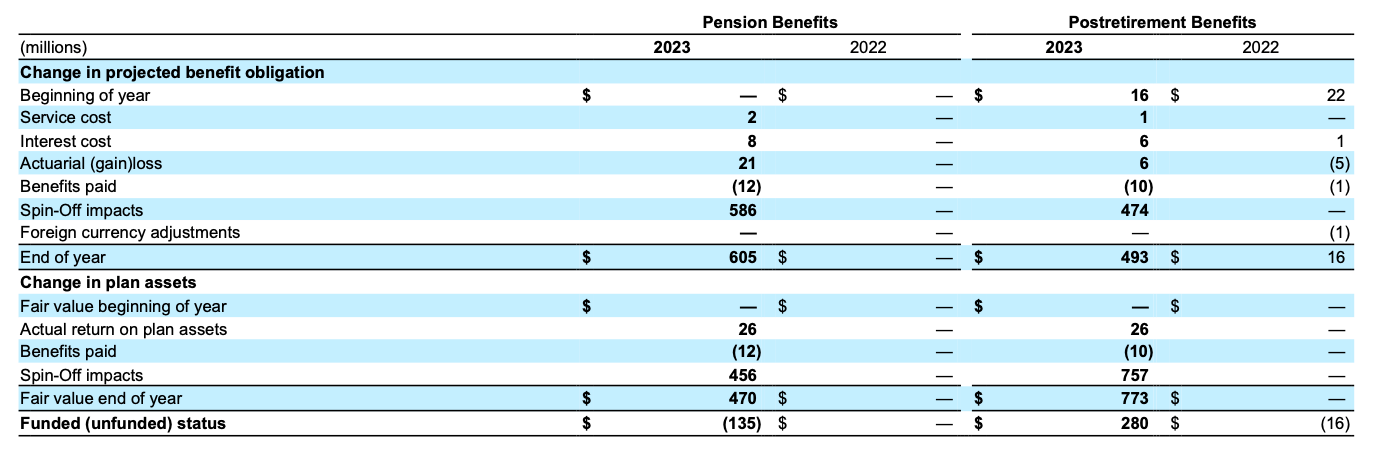
When retirement-related assets and liabilities are too small to disclose on the face of the balance sheet, companies will often elect to include prepaid pension assets within long-term assets and unfunded pension liabilities in other long-term liabilities, disclosing the details in the notes. For example, W.K. Kellogg, in its 2023 10-K, provided the details of its retirement-related assets and liabilities in note 9, “Pension and Post-Retirement Benefits”, starting on page 70. In 2023, the company had around $1.1 billion in pension and post-retirement benefits, against plan assets valued at $1.24 billion, for a net funded status of $145 billion. 

The $145 million in excess funds tied up in the plan assets are given the same treatment as excess cash and do not form a part of the invested capital calculation. Instead, that $145 million is dedicated from my invested capital calculation, because it is not needed to generate any returns, it is dead capital. On the other hand, underfunded plans are effectively borrowings from the employees, and do not require any adjustments to invested capital calculation.

Scroll to Top